
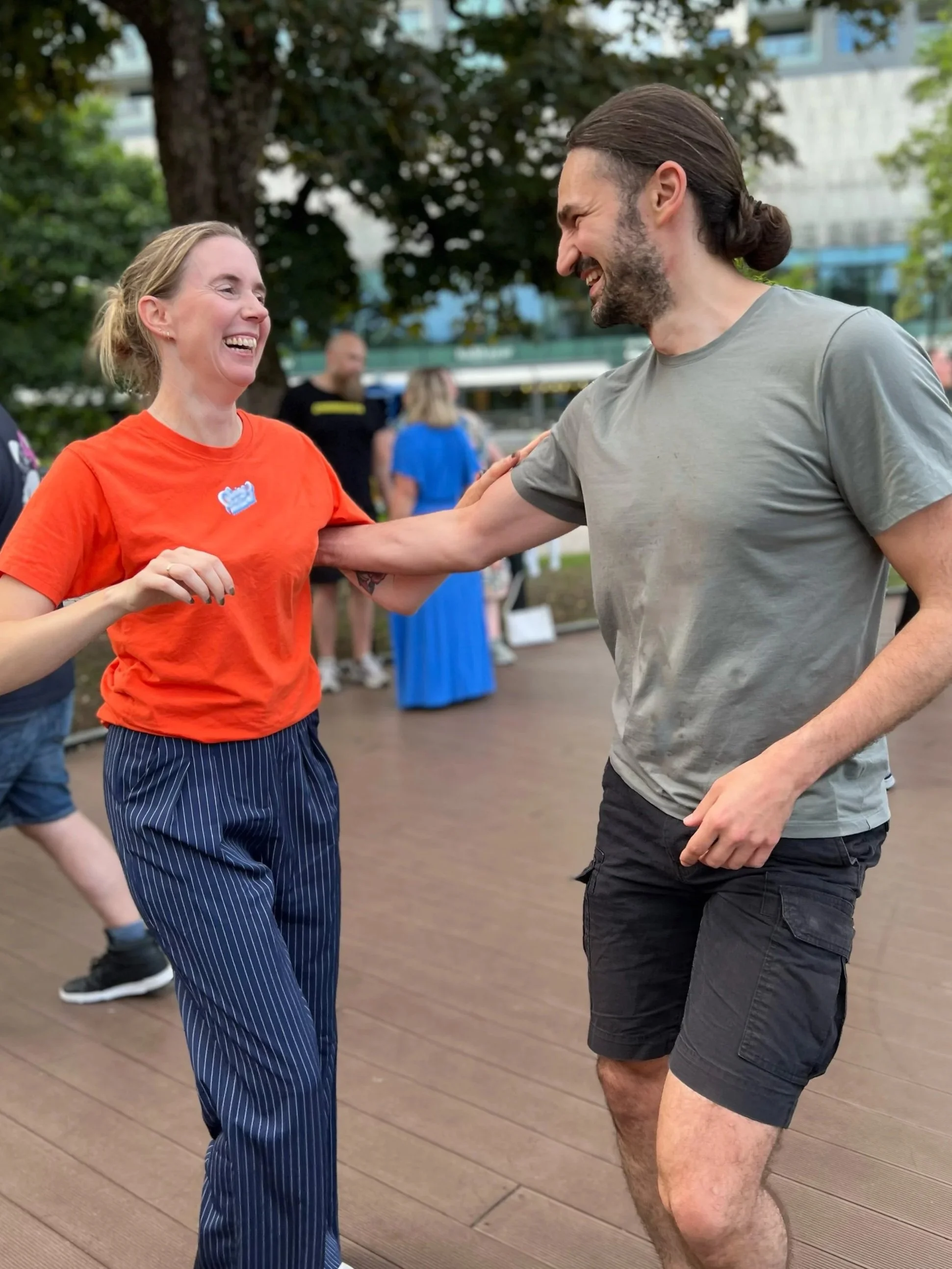
Om West Coast Swing
West Coast Swing kallas ofta för den moderna swingen, eftersom det är den swingdans som har utvecklas tillsammans med musiken.
Det har gjort det möjligt att vi idag kan dansa till ett brett spektrum av olika musikgenrer, från klassisk jazz till modern pop och r’n’b.
Dansens histora
West Coast Swing har sitt ursprung i USA, där den utvecklades från lindy hopen under 1930-talet. Den blev särskilt populär i Kalifornien, där den även utsetts till delstatens officiella dans. Dansen har sedan utvecklats i takt med att musiken förändras, då dansstilen har låtit sig influeras av andra danser. Under 80- och 90-talet var det disco, hustle och blues som influerade dansen. En stor förändring kom under 2000-talet, då dansen började spridas utanför USAs västkust och anammades av en yngre generation som anpassade stilen till modern popmusik. Latinamerikanska influenser, som Zouk, har även lagt till nya dimensioner i dansens rörelsespråk.
Dagens West Coast Swing
West Coast Swing beskrivs oftast som en modern och lekfull partnerdans som passar till en stor bredd av musikgenrer, såsom pop, r’n’b, blues, hip-hop och jazz. Dansen har en avslappnad och improvisationsvänlig stil där dansarna uppfattas “flyta över golvet”.
Till skillnad från många andra partnerdanser, som dansas till en specifik musikstil, kan West Coast Swing dansas till det mesta i 4/4- eller 12/8-takt, med ett tempo från 70 upp till cirka 120 bpm. Detta gör dansen väl anpassad för både klassisk jazz och modern pop. Dansen kombinerar lekfullhet, musikalitet och improvisation, där följaren får ta en större plats i jämförelse med många andra dansstilar. Dansen anses därför vara en väldigt socialdans där fokus är på partnerskapet, föra och följa, där båda roller får ta plats att uttrycka sin tolkning av musiken.
Det som förstärker den sociala känslan i dansen är att vi ofta dansar en låt och sedan byter partner under en danskväll, där både förare och följare bjuder upp. Detta ger varje person möjlighet att dansa med fler under kvällen, vilket upplevs som både omväxlande och välkomnande.
Tävla i west coast swing
Det finns inga krav på att tävla utan West Coast Swing brukar ses i första hand som en social dans. Men för den som är nyfiken på att tävla finns det några olika tävlingsformer inom West Coast Swing. Den populäraste tävlingsformen är "Jack & Jill", där deltagarna paras ihop slumpmässigt och sedan dansar till en slumpmässigt vald låt. Det kräver en god förmåga hos den tävlande att snabbt kunna anpassa sig både till sin partner och till musiken.
På stora tävlingar, licensierade av World Swing Dance Council (WSDC), kan dansare samla poäng genom att tävla i Jack & Jill som möjliggör avancemang till högre tävlingsklasser. Vi har många talangfulla och skickliga svenska West Coast Swing-dansare som tävlar i en av de högsta dansdivisionerna, bland annat Victor och Evelina från Uppsala som dansar i divisionen Allstar.
West Coast Swing is often referred to as modern swing, as it is a swing dance that has evolved alongside the music.
This has made it possible for us today to dance to a wide range of different music genres, from classic jazz to modern pop and R&B.
The History of West Coast Swing
West Coast Swing originated in the United States, where it developed from Lindy Hop during the 1930s. It became particularly popular in California, where it was also designated as the state’s official dance.
The dance has continued to evolve alongside changes in music, as the style has been influenced by other forms of dance. During the 1980s and 1990s, disco, hustle, and blues had a significant influence on the dance.
A major change came in the 2000s, when the dance began to spread beyond the West Coast of the United States and was embraced by a younger generation, who adapted the style to modern pop music. Latin American influences, such as Zouk, have also added new dimensions to the dance’s movement vocabulary.
West Coast Swing Today
West Coast Swing is often described as a modern and playful partner dance that can be danced to a wide range of music genres, such as pop, R&B, blues, hip-hop, and jazz. The dance has a relaxed and improvisational style, where dancers are often described as “floating across the floor.”
Unlike many other partner dances, which are typically danced to a specific style of music, West Coast Swing can be danced to almost anything in 4/4 or 12/8 time, with tempos ranging from around 70 to 120 BPM. This makes the dance well suited to both classic jazz and modern pop music.
The dance combines playfulness, musicality, and improvisation, with the follower taking a more prominent role compared to many other dance styles. West Coast Swing is therefore considered a highly social dance, with a focus on partnership, leading and following, where both roles have the opportunity to express their own interpretation of the music.
What further strengthens the social aspect of the dance is that dancers often dance one song together and then change partners throughout the evening, with both leaders and followers inviting each other to dance. This gives everyone the opportunity to dance with more people during the evening, making the experience both varied and welcoming.
Competing in West Coast Swing
There is no requirement to compete, and West Coast Swing is primarily considered a social dance. However, for those who are curious about competing, there are several different competition formats within West Coast Swing.
The most popular competition format is “Jack & Jill,” where participants are randomly paired with a partner and then dance to a randomly selected song. This requires competitors to be able to quickly adapt both to their partner and to the music.
At major competitions licensed by the World Swing Dance Council (WSDC), dancers can earn points by competing in Jack & Jill competitions, allowing them to advance to higher competition levels.
Sweden has many talented and skilled West Coast Swing dancers who compete in some of the highest divisions. Among them are Victor and Evelina from Uppsala, who compete in the Allstar division.